Perhaps it's because I'm more involved in Twitter these days but I'm finding more and more evidence that Twitter is jumping the gap - beginning to cross the chasm between early adopters and going mainstream.
Of course, for some, this is about as welcome as jumping the shark but this is the stage of maturation I really love. I love the discovery of something new, figuring out how it can be useful, and then sharing that vision with others until they get it themselves. My first experience with this whole World Wide Web aspect of the internet was like that and now with Twitter, I'm actually melding that with a return to a comfort zone distinctly reminiscent of the early days of BITNet.
Near daily, we're finding new uses for Twitter. Now that it's not just about what sort of coffee drink the person in front of you is ordering, it's not just about marketing either. During the snow storms last month in Seattle, finding out weather and road status were invaluable tools for coping with all the disruption.
And Twitter is great for breaking news. Tweets today started full of news and speculation about Steve Jobs and quickly moved on to subjects like the plane crashing in the Hudson River and other topics that regularly take a bit more time to reach mainstream media.
In fact, it was at least three days between when I heard about the pantsed Vail skier via Twitter and the first forwarded email in my inbox. News junkie that I am, I'm following news-oriented Twitter accounts as fast as I can discover them.
From these uses, it's not at all a big leap to thinking of using Twitter in emergency situations including using Twitter as an emergency broacast system and the possibility of having Twitter play a role in a larger technology solution for emergencies and disasters.
Twitter has been a great discovery mechanism as well - finding new people, finding blogs like the one published by Washington State Department of Transportation and finding lots of other great sites and interesting information.
It wasn't so very long ago when the notion of being rescued with Twitter was a big deal. Now that this seems an obvious go-to, I wonder where we'll head next with this technology. We like to make predictions this time of year - how do you see Twitter being used in the future and what would it take to get there?
In any case, the pattern I've noticed is technology is often used for fun before it's real usefulness is identified and put to work. It doesn't hurt to think about what's fun in our own lives and how that might be made useful.
How do I use technology to move me forward?
Thursday, January 15, 2009
Twitter - Jumping the Gap


Thursday, November 13, 2008
Some Off-the-Grid Internet Scenarios
A while back, I mentioned the possibility of a future where we might have internet off the grid. Based on comments I've received and ongoing search statistics, this seems to be a popular topic these days, so maybe it's time to elaborate further.
First, let me make extremely clear - while mostly knowledgeable in most of the areas I delve into here, I am far from expert. I would, however, love to get a dialogue going on the subject, as I believe it's a useful converation to have. At the very least, there are enough different implications here for multiple science fiction stories. There may be some business opportunities too.
Scenario - Commercial power available but in limited quantities
If society has access to some but somewhat limited amounts of commercial power, then obviously there would have to be some kind of prioritization or auctioning to decide who has access to that power. Think television/radio spectrum frequency distribution. Under such a set of circumstances, I can imagine that at least some server farms might have access to at least some commercial power but it might not be 24x7. Average businesses and individuals would likely not have access to commercial power - if they did, we wouldn't need this conversation.
If this scenario were to come about, then much of the internet might look from the outside like it does today, except that businesses and individuals would need individual power supplies such as from solar, wind, or geothermal sources in order to connect to it. You'd have access to the internet pretty much as you're used to now, just not all the time like we have today.
Since others would be in similar circumstances, you might be able to access static data (such as website pages) right away but something like an email response to a question (especially involving other individuals and smaller businesses) would be somewhat delayed. Solar-powered wi-fi routers mentioned in my previous post would be an important element in keeping such a system working.
Scenario - Little or no commercial power available
In a more post-apocalyptic scenario, there might not even be enough commercially-available power to run server farms but that doesn't mean the internet has to go away altogether. We've gotten used to the near-instantaneous nature of data transmission across the internet but those of us who remember the days of Store and Forward know that data can still move even when it gets held up for a while.
In my imagination, it would look a lot like the ham radio National Traffic System which uses local traffic nets to help move information. Ad hoc peer-to-peer connections would come up and down according to each individual's access to power and like a bucket brigade, or BitTorrent sharing, we'd pass along each other's traffic while accessing what we want for ourselves the same way.
Quite possibly, the data requests we make ultimately will be delivered to servers that aren't themselves up 24x7. The result would be request, delay, fulfillment - or, a lot like how cross-oceanic calls used to be placed where the request would be made of an operator who would make the connection while you're off-line and then ring you back when it was available. If that's too challenging for modern minds to fathom, think instead of holding for a call from the President.
In such a situation where data must regularly travel multiple intermittently-available routes, it may be that some additional protocols must be developed to optimize transmission but it's surely possible, even if it means falling back to simpler data types. Error correction would be the biggest problem. If a packet gets dropped along the way, it could take days to put it all back together again, depending on the severity of power accessibility. We're definitely talking about a different sort of animal than what we've become used to.
The solar-powered wi-fi routers would be a virtual necessity to make such a system very workable and almost certainly some social engineering would be required too along the lines of scheduling uptime so that data requests could be made and forwarded in a "timely" fashion.
Each scenario would have its own impact on what everyday life might look like but some commonalities exist. With a shortage of fuel, it's likely we'd be living in smaller communities oriented around food production. But instead of the near-isolation of frontier towns or the relative lack of communication between older European villages, we could still communicate and share with one another digitally.
If there is enough commercially-available power, we may even be able to continue with much of what we've come to expect is normal in terms of information-age business and commerce except that working in remote virtualized groups would be more common than larger groups housed together in cities.
Of course, if cities get better about their own food production, that would be another game-changer and there are some interesting possibilities around that as well. For that one, you'd have to talk to my brother-in-law - he's got some great ideas. If it's something that interests you, let me know and I'll put you in touch.
How do you see the future?
Monday, October 06, 2008
I'm Not There
 Too bad they haven't invented functional teleportation yet. If they had, perhaps I'd be in Great Falls this afternoon and evening celebrating the 50th Anniversary of KRTV. It was a pivotal time in my life (one of several, anyway) and I have some distinct memories of that time - the threads of which remain interwoven in the tapestry of my life even still.
Of course, I have special memories from each of the stations I worked throughout various western small markets. Today though, is a day set aside to remember forecasting and reporting around the Golden Triangle.
Some of my KRTV colleagues will remember the guy who would regularly drive all the way to Great Falls from Seattle just for a long weekend (and then arrange for me to receive a dozen roses there at work the day that he left). They might be pleased to know that three television stations and several years later, we finally married and settled here in the Seattle area.
One enduring memory from KRTV would be the struggles I always had trying to wear the battery belt for the light when out shooting news on my own. Being considerably smaller than the regular photographer, the belt was way loose, and with my hands full carrying the light stand, the camera, the deck, and the microphone bag, I always had a tough time keeping it from slipping off my waist.
I also remember one of the first times I edited a story on my own, it took me so long that I had just enough time to run it up to engineering and then sprint out onto the set (think Broadcast News) just as we were coming into the weather segment. I was so out of breath from running up the stairs that one woman called the station to inquire whether I was feeling okay. To say that I was mortified would be an understatement.
Professionally, I learned a great deal about broadcast journalism from the news director, Mack Berry, and everyone else there at KRTV that I was able to then take successfully into stations in El Paso and Omaha where I did health and science and environmental reporting in addition to weather.
As just one example, one day at the police station briefing, the only item of particular note was the theft of some 14 cases of diet bars from the weight loss clinic. Not sure how to make that newsworthy, Mack sat me down and taught me that anything can be written funny and so that’s how I wrote that story. That knowledge (along with some understanding of when to use it) has served me well for many years.
What I remember most, however, was how much everyone at KRTV and so many other people in and around Great Falls took me into their hearts and homes. One elderly couple even drove 75 miles one day just to come to the station and visit with me for a bit, showing me their book of family history in case we might be related. It touched me so much that I was making that kind of difference in people’s lives that I stayed working in television for 5 years until I finally came home to get married.
Thank you all for teaching me so much and for being such wonderful friends while we were together.
What memories of today will stay with you?
Friday, October 03, 2008
Pigsquatch, Whales & the Economy
We love My Name is Earl at our house. Watching the final fate of Pigsquatch last night had us rolling on the floor, despite my not being that big a fan of gross. Then in the midst of gasping for air, Tall Person suddenly flashed on a news story he remembered from when he was at KOMO "way back when".
It seems a reporter at KATU, their sister station in Portland, wound up covering a strikingly similar situation in the early 70's. Sure enough, searching YouTube for Oregon whale, he immediately came up with exploding Oregon whale. Bingo!
Our other conversations of the evening turned to the economic crisis, understanding the innate problematic nature of sub-prime lending and how we got into the stinking mess in the first place of trying to decide to do a bail-out or just let nature run its course, and don't forget too the whole "money as debt" issue on top of it all (thanks to Brad for pointing that one out - when I find the exact post, I'll link to it).
We appreciate the dark humor in September Madness, but even so, the whole matter is definitely a stinking whale carcass on the beach and a giant hairy pig in the middle of a trailer park. Stinks to high heaven and no one wants to touch it.
It could be that just like with Pigsquatch and that whale in Oregon that there only seems to be one viable option because everything else is so much worse. If so, history would seem to indicate you do the best you can to avoid the most obvious problems, and then make sure everyone is as far out of the way as possible from the fallout. Of course, the other possibility may simply be that the cure really is far worse than the problem.
The trouble is, how do you ever know for sure? And how do you prevent that uncertainty from paralyzing you in your tracks?
What works best for addressing the stinky problems in your own life?
Tuesday, August 19, 2008
My Hero
 Sunday, we had a family celebration of his 97 years, the day before his birthday. The cutest photo of the day included Grandpa Joe (Grandy) and a various assortment of some of the younger grandchildren and as many great-grandchildren who could make it.
 Who is your hero?
Monday, July 21, 2008
Anniversaries
Sixteen years ago yesterday (a Monday that year), I walked into the Attachmate offices in Factoria for the first time as an employee. I didn't have a phone, computer or even any furniture, so it was tough to do much, but they sat the two of us who'd started that day down with video tapes of Lisa Ford teaching great customer service skills. I soaked it up because there wasn't anything else to do with my time.
Though I heard lots of complaints from other people about those tapes, I haven't ever come across anything else that teaches customer service any better than that. For customer service, Lisa Ford is my hero.
I'm not sure exactly when the furniture arrived - that was the joke - "Do you have furniture yet?" Some new hires went a couple of weeks or more in those days without even having a chair to sit on because they hadn't found or purchased a spare one yet. Hiring was outstripping the capacity for facilities to keep up.
What I do know is that the first thing to arrive, even before the computer was the phone. That was in the afternoon of Day 2 or 3. Anxious for something to do that approximated technical and/or troubleshooting, I started punching buttons. Hey, why not?
Here's why not... suddenly I found myself connected with an inbound customer call and I had no idea whatsoever of how to handle it. I had no computer, no product knowledge yet, and no idea even how to transfer the call to someone else who could help. Heck, I hardly knew the names of the guys who sat near me.
"Psst! Kevin! I ended up with a call by accident, what do I do?!" Kevin (I think it was Kevin; honestly, it was 16 years - less a day or two - ago!) was kind and patient enough to walk me through the steps to transfer the call and he took it from there. Whew! Get this girl a computer, stat! It'll be so much safer that way and far better for everyone!
The weekend after I started, I got married so in five more days, I'll be celebrating my 16th wedding anniversary too. Somehow, it never occurred to me to negotiate anything beyond an extra hour of sleeping in the day after my wedding so I wandered in at the leisurely hour of 8am that second Monday of work. Somewhere in there, I ended up with a computer and a copy of the software I'd be supporting - EXTRA! for Windows. We wouldn't be trained until the rest of the new-hires started, so I began by seeing what I could figure out for myself. That turned out to be a pretty reasonable strategy as it also gave me an opportunity to assess how intuitive the software was and provide some feedback to Development.
Over the course of the next couple of weeks, the rest of the Summer of '92 class started. One of them is, to this day, one of my closest friends, as is another of my co-workers who had started a month or so ahead of me, and a high school friend of mine who had started there another couple of months before that. Another co-worker who first decoded the mysteries of hardware adapter I/O addresses and interrupts ultimately became my boss, mentor, and well-respected (by way more than just me!) friend, teaching me more than any single other person I know about what it means to be an effective leader.
In some ways, the intensity of that time period, all that we learned and gained, and the lasting impact (friendships and otherwise), had a certain summer camp feel about it. It's tough to believe it was that long ago, or that I lasted at Attachmate a total of nine years.
Long gone are the days when so many calls came in that we could never get to them all real-time, leaving the departmental receptionist to keep up as best she could with taking down names and phone numbers such that we would head up between calls to grab a stack of "callbacks". Ultimately we brought in enough new-hires and refined our processes enough to make that particular approach a thing of the past.
We also matured to the point where we were able to have desks all set up for our new hires - with a chair, even! As a manager, I always ensured that my employees never received a phone without also (or first) having a computer, even if it meant I had to steal the phone for a while until the computer arrived. You never quite know what sort of trouble a geek will get into if they haven't got a computer to play with.
If you have enduring memories of a past experience that still impact you today, do share. Or maybe there is some anniversary you're celebrating. Let's hear about it.
In the meantime, thank you from the bottom of my heart to Shawn, Burkery, Toot, and Eric (E). I'm better for knowing you. And best wishes to Renee and Shauna, whatever you're each up to these days. As Garrison Keillor might have said, it was a group that time (almost) forgot and decades cannot improve, at least in my memory.
As for my husband, the tall person, this is about the time when I remember our anniversary is coming up soon, so I'll say now - thanks for continuing to love me all these years. I know that living with a geek isn't always easy and you've made it seem to me and the rest of the world like it is. I love you (still!) for that and so much more.
What (besides a chair) do you need to get started?
Monday, April 21, 2008
I Know What You're Watching
We watch far more television in our house that I care to admit or really have time for - the adults anyway. I usually blame it on the general interest that drew us to or grew from our time in television. Lately, I've been spending more and more time surfing or doing other work while watching and I've noticed an interesting convergence between television and the internet. I know what you're watching and last night, it was Kipling.
Maybe you've noticed this too. I know what you're watching because I have the Google Hot Trends gadget on my personalized search page (which, btw, I've finally further personalized with the Tornado theme) and when we all watch TV in the evening, we apparently all surf the web to look up stuff related to what we're watching. While all of you were looking up Rudyard Kipling, his son, Jack, and the poem, we were trying to figure out why Kim Cattrall was playing the wife and mother, Carrie. I won the bet that she was an American. 
Whenever I find names on the 'hot sheet', invariably they're names of American Idol contestants the night that they got voted off or Simon said something particularly interesting about them. It was interesting to see so many of the top spots related to the Kipling movie, a public television offering that apparently received way more attention than I'd have guessed it might.
As much as TV rules at night, in the morning it's all current events. Last week it was the midwest earthquake and the New Madrid fault system. This morning, the Kiplings and My Boy Jack are old news and all but Rudyard himself have been pushed off the top ten by Bill Maher, the Boston Marathon (go Brian and Carol!), and what I can only guess is an early morning porn rush. Not sure what that was about - that one was strange.
It's this sort of convergence that makes me curious to see what the future will bring in terms of entertainment and information and blending the two. If you have comments or predictions, I'm interested. Go ahead and share your thoughts.
How does your thinking affect your actions?
Sunday, November 18, 2007
The Changing Nature of Communication
You can tell we're in the midst of a shift that doesn't yet really know where it's going. The below-30 crowd almost exclusively communicates very publicly with one another using Facebook and MySpace while at the same time somehow expecting more privacy than such openness would suggest. The over-30 crowd, having mostly come to terms with the usefulness of email, is starting to venture into social networking a bit late into the game. They're not quite certain of its relevance in their own lives and more wary of the additional exposure.
While these things shake themselves out, I keep coming back to thinking about how what we say is impacted by how we communicate.
Over the years, I've given a fair amount of thought to that. There was a time in my life when the idea of a graduate degree - just to have done the work to get one, not for any particular use for the degree itself - was appealing to me. As my mind wandered down that potential path, I pondered over what sort of research I'd want to do. The question that interested me the most was "How does the method of communicating impact the nature and effectiveness of communication?" - or something like that anyway. I'm sure a good advisor and mentor would have helped me refine the question into something better if I'd ever gone down that path in reality.
Context is helpful here. When this question first came up for me, I was a college student at a time when only scientists, military, and government had ready access to the internet as a general group. College students, if they had access to the computing labs did too, but that capability was generally limited to those of us in engineering or computer sciences in the earlier days.
This also pre-dated today's ubiquitous cell phones, and flat-rate long distance plans and inexpensive calling cards were also still well out in the future.
So, the communication landscape of the day consisted primarily of letters and post-cards. If you had money and it was worth the expense, you might call long distance on the telephone occasionally but it was something a starving college student thought about before doing... and even then, we tended to count on parents with enough money to reverse the charges and kept the calls fairly short out of necessity.
In mass communication, the notion of satellite transmissions making a broader range of television programming available to more people was just catching on for real, finally becoming more of an expectation than a novelty or luxury. The 24-hour news machine that burst onto the scene in the form of CNN coverage of the transition from Desert Shield to Desert Storm was still in our future. We were just getting cozy with the joke of "50 channels and nothing to watch."
These days, it's more like eight hundred and fifty. And still nothing to watch.
When I think of the fact that being limited to these forms of communication is entirely foreign to my 11-yr-old and as good as that to the 23-yr-old in my family for all he remembers of life before the digital divide opened up into a chasm, it boggles my mind.
Pen pals were fun to have but the time it took for letters to transit state lines took special care and nurturing to keep the relationships going. Overseas pen pals were even more cool but further complicated by the typical two week lag (one-way!) and the space restrictions that accompanied the use of the "aerogramme" letters. Still - if you ever received one, that characteristic lightweight - nearly flimsy - blue paper held such an exotic quality that it made one think of faraway places and the other cultures found there.
The real-time chattiness of phone calls was reserved for cross-town family and school friends. Cross-country calls were rare for "regular folks" and were usually placed only if there arose some urgent need - such as to communicate a death or some grave illness. I don't recall much overseas calling at all - telegrams were still the more common method for communicating urgent messages and paying by the word meant everyone kept telegrams brief.
Having grown up as a world traveler at a time when such a life made me and my lifestyle exotic, the global nature of relationships made possible by the Internet felt like coming home. I felt at more at ease with BitNet communications than any other form I'd experienced previously. I temporarily lost any sense of urgency with regard to ham radio and fully embraced the beginning of the digital age.
And this is when I began to notice that just as email was different from snail mail (though I doubt we'd really started calling it that yet - more likely it was just 'real' mail) and phone conversations, it was becoming clear that email was also different from group internet relay chat, which was also different from the person-to-person BitNet messages, with their 80-character limitations.
Have something quick to say with the expectation of a real-time response... send a BitNet message. If you want to say more, save it for an email. These days, text messaging is similar to that earlier counterpart, but more prevalent because we all have cell phones and so with an even greater expectation of immediate responses.
The more public, group orientation of Facebook adds yet another dimension to communications while Twitter is particularly well-suited for announcements made just in case anyone out there cares. In fact it doesn't seem a lot different from times when Small Person (along with others I've known) announces to no one in particular that he's heading to the bathroom. Good thing he's far less technical than I am at this point. Maybe he won't feel inclined to be mad at me by the time he realizes I've invaded his privacy in such a public way.
The question of privacy in an online life is a tricky one. I don't pretend to understand how we'll come to terms with that one. The best I can guess at this point is that we may adopt some digital version of the traditional Japanese sense of privacy. In a world where many walls were nothing more than shoji screens, made with translucent paper, Japanese created privacy where there was none by politely pretending not to notice anything that couldn't be seen directly. Such sensibilities have even spilled over into forced face-to-face environments such as trains where crowds are necessarily able to see and hear things they might prefer not to witness.
Already I have friends online with whom I'm likely to pretend when together in person that we don't know as much about each other's private lives as we do. We're open and honest with one another and I believe that's admirable - it just shouldn't come back to cause problems or embarrassment later.
Until we figure it out, I think of my online presence in much the same way as I think of keeping teeth brushed and hair combed. Good personal hygiene is good practice anyway - and really important to make sure it's done before leaving the house. Similarly, I still advocate being ourselves - our best selves - online. Being our best selves means that we don't have to worry about whether parents and bosses are watching - which they probably are these days, along with a lot of other folks. .
It's an interesting conversation to have - what we have to say to one another, how we say it and what sort of expectations we have (and can have) around privacy - and whether that's the same as anonymity. I definitely encourage you to comment and get the discussion going. The more publicly we hold the conversation, the more robust it will be.
What do you have to say, and to whom?
Wednesday, October 31, 2007
Yes, It IS Big News
It's interesting watching the comments fly about Microsoft purchasing a stake in Facebook... and now just a couple days later, Google announcing OpenSocial. Despite some cynics, I contend that this is a big deal.
Social networking technology is finally catching up to a pent-up demand to satisfy the desire to connect with other people, despite living in a harried and fractured world. Facebook, MySpace, LinkedIn and others have each addressed part of that need while at the same time, segmenting our lives further by remaining as entirely separate silos.
I'm not alone in feeling like it's crazy-making to keep up profiles across several different networks... or to choose to focus on just one or two to the exclusion of others.
People of all demographics want to feel connected. The younger folks, the young at heart, people who want to stay connected with them, and people who don't want to be left behind while the hiring game changes, all want to use technology to do this. That's a pretty sizeable group of people when you start to add it all up.
Most importantly, these people want social networking to make life easier and better, not harder, and the technology is finally beginning to catch up to that.
Of course, it mostly starts out with forging virtual connections with people we already know and care about in real life. As that capability matures, however, there is the capacity to learn more about each other than we often learn IRL, and to learn more about people we didn't even know before. So yes, these kinds of moves by the giants of the industry definitely could have an impact on quality of life and understanding fellow humans.
More than a decade ago, back when most of the folks I knew didn't even know what the internet was (including many of the geeks I worked with), and only a handful were just starting to get the idea about email, and the best form of electronic connectedness most of us had was through electronic bulletin boards of which only a handful were connected to each other... Way back then, Howard Rheingold wrote The Virtual Community, and it really spoke to me. I tried speaking to him too, but that didn't really go anywhere at the time.
Between then and now, the Internet became more widely accessible (and I only had to suffer through ten years' or so worth of withdrawal, after leaving school), started to offer more to the average person, and connecting electronically has become second nature to most of us. Between then and now, I and about 150 other women and some of their partners came together through the internet in support of one another throughout the duration of our pregancies - and our group was just one of many.
Though I can't speak to the others, I can say that our group is still going strong nearly a dozen years later, and I'm sure that between us, we can name every one of the people who was ever part of our clan (plus most of their kids and partners and a lot of other relevant details about their lives), even if they're not still an integral part of our thriving community today.
We're very close-knit and the connection we share electronically has been a real important part of our day-to-day support through pregnancy, child-rearing, trying to being good partners in our relationships and how we show up in life and work in the broadest possible terms. We help each other maintain sanity, offer differing points of view for consideration, celebrate successes and provide plenty of {{virtual hugs}} during times of grief and challenge.
If you want an example of how people can use virtual communities to improve quality of life and understanding of fellow human beings, just ask me about the November Moms of '96. And make sure you have a lot of time to stay and get the answer.
How will this new wave of technology-aided and abetted community shake out? I'm not all that sure yet - but I can tell you that I'm mostly excited about it. The news of the past week makes a lot of new things possible. That's great news for those of us with social networking on the brain. It's also great news for Startup Weekend participants or anyone else tapping into the value of community on the web.
In the meantime it's probably a good idea to go back and read some of Howard's thoughts on the downside of virtual communities - while the examples are perhaps dated, he accurately predicted a lot of what we've seen since his original writing of it all and the risks that haven't already been realized are still out there. It's probably a good idea to spend at least some time thinking about how to mitigate those risks and to keep thinking about how to realize the full potential of this notion of a virtual community that complements, not replaces, the real thing.
You probably have thoughts on the matter. I'd love to hear stories, predictions, concerns - whatever. Send them to me at techsurvivor@soaringmountain.com and help design the future.
What does community mean to me and how do I express that in my life and work?
Wednesday, September 19, 2007
Retro Me This...
As forward thinking as I tend to be most times, I definitely have a nostalgic side. I make my kid listen to Bad 70's Music. If I decide I'm really comfortable in the clothes I wear one day, I might just wear them again the next day. Especially if I think you haven't already seen me in them. Today, I'm wearing my now-vintage Attachmate Hardware team vest, complete with the old heart logo. I realize that old logo caused plenty of confusion - and I'll miss it anyway.
I recently spotted an AmazonFresh truck here in Bellevue, and it brought on such a wave of nostalgia, I nearly swooned. Okay, so not really, but it was a way cooler sighting than most people would probably think it to be. So, does anyone know - are these the old HomeGrocer trucks repainted? It sure looked like it to me.
Despite the ease with which some people ridicule HomeGrocer as a failed dot-bomb, I am proud to wear the hat with the peach and I am glad to see the return of the trucks. I'm not a former employee, as plenty of other parents at soccer games have guessed. Just a former customer who was quite loyal to to the service.
Back in the days when Small Person was a young toddler and Tall Person and I were both working full-time in the corporate world, getting groceries delivered was about the only way food was going to enter our household unless you count doggie bags.
HomeGrocer understood their market very well and did an excellent job bringing treats and fresh fruit samples to keep me thinking of things I might add to my next order. Although I haven't tried out AmazonFresh yet, there are some hallmarks of the earlier service that sound very familiar and I'm guessing it's the same business getting a new life under a different name.
Don't expect to catch me at a casino to see some favorite act from my youth anytime soon, but I do enjoy a good comeback. You can bet I'll be looking for a reason to order groceries online pretty soon... and chances are pretty good I'll be wearing that vest when I do. For the second (or even third) day in a row.
Send your experiences with AmazonFresh to techsurvivor@soaringmountain.com - especially if you're a former HomeGrocer customer, and let's compare notes. I'm curious if the market has shifted enough to make this venture a go or if they'll have learned enough from the first failure to make this effort a success.
What's worth keeping or bringing back in your life?
Wednesday, July 18, 2007
Contextualize Me
The resident small person is pretty sure today that I'm crazy. We had a good gentle soaking rain going and since he was bored, I had him entertain me with the tale of Hansel and Gretel. After writing about trails of breadcrumbs recently, I panicked momentarily, thinking perhaps he didn't know the story and therefore might not understand the significance of things like breadcrumbs in current parlance.
It turns out, I didn't have any reason to worry - he was able to tell the story quite well with full detail and a lot of good storytelling technique. Apparently it's in one of his books; I guess we've been better than I'd feared at ensuring his cultural literacy. Whew!
It's in the interests of establishing a fluency in cultural literacy that I let the small person watch and encourage him to listen to old stuff that shaped my own generation and those that came before me. At least I hope it's more that than bad parenting or an occasional guilty indulgence in what we jokingly refer to around our house as "Bad 70's music" - and no fair saying that's redundant!
I believe in the adage that those who are ignorant about history are doomed to repeat its mistakes. I also believe that understanding context is key to understanding anything. You know - the inside jokes, kind of had to have been there kind of thing?
I'm sure you run into the same sort of thing at work - where there is historical context that is as critical to avoiding past mistakes as it is to understanding current language, decisions, culture, and so forth. That doesn't mean living in the past or adhering to old practices simply because "we've always done it this way." History needn't lock us into the same old problems. Sometimes what didn't work before will work now because the situation has changed. Understanding the context helps provide the clues as to what will work best in the current situation based on what has gone before.
What we need in organizations are storytellers who can capture the history and keep it fresh for all who need it. If that person isn't you, I hope you know who is!
I'm interested in your thoughts on the relationship between progress and historical context. Send them to me at techsurvivor@soaringmountain.com and let's find the the creative edge between past and future together.
What am I doing to capture and learn from where we've/I've been?
Tuesday, September 26, 2006
The Play Paradox
Somehow we've got the notion into our heads that playing is somehow trivial - less important than "real work". Fortunately, I've seen enough evidence to the contrary that I rarely feel guilty anymore about playing, even when I'm getting paid to do "real work". I suppose part of it is feeling subversive, but only part. The truth is, as much as I enjoy having fun playing, I enjoy even more discovering how that fun can be turned into something useful. It's rewarding to see the playtime pay off but it can't be about the payoff or it's not real play. That's the paradox of play. To riff off of Julio Olalla a bit, only true purposelessness (when it comes to play anyway) can lead to purpose.
One of the first times I really understood that was back when I first got to try out this new application called a web browser. I was at that time suffering rather serious withdrawals as a result of no longer having access through the academic world into BITNet - one of the early incarnations of the Internet. Fortunately, the whole world wide web thing started getting really popular about then, and suddenly, for the first time, it was both cool AND okay for corporations to get in on the game. And so I started playing around with it. I made sure I got my work done but make no mistake, I was playing - using company access to the Internet and company time, I was fooling around, learning what I could about what was out there and how I could find it and how it all worked. It was fun, pure and simple.
Of course no one else around me seemed to really get what was fun about this. My analogies to a library that constantly responded to whatever ADD-like impulses might strike, following idea upon idea just by clicking something as mysterious as "hypertext links" was, at the time, fairly inept. I kept at it, though and friends and family mostly tolerated my craziness. Then one day, I ran across information about the hypertext markup language itself that made the whole world wide web a more user-friendly place than had been the BitNet-based file storing and sharing of my college days. Just click on a link and you're there. And wonder of wonders, I was delighted to discover that HTML wasn't at all complicated. In fact, for a small fee, there was even a relatively inexpensive editor you could get that made the coding work even easier.
Excited about the prospects and what we might be able to do with such capabilities, I took the idea to my boss. I didn't have a lot to show him at that point except for a lot of hand-waving and more library analogies. While academics had been using it for quite some time by then, the internet was still mostly a place to play at that point for the average corporate hack. But there were a small handful of companies that had started to put up customer-facing websites and a couple of them were even involved in our market - networking - and so I managed to convince my boss that our company ought to think about having a website too. We could publish the kinds of solutions and information we were currently providing our customers via fax and BBS. It would be a great resource as more and more people began to see the power and usefulness of the internet. It would give me an excuse to play some more.
Ultimately, my manager saw enough in my suggestion that was worthwhile to say that he at least wanted to see more. Could I do a mock-up of what I had in mind so that he could see how it might work in reality? He even gave me the money to get the HTML editor. It was called HoTMetaL . That summer, my stepson spent most of his time at his grandmother's so I had relatively few family duties for the entire month of July and a good chunk of August. I put in a lot of 14-hour days learning how to create a website, building the proto-type, and populating it with the kind of information I thought would make it useful. It was some of the most fun I've ever had and I like to believe that I mostly enjoy life as a general way of being most of the time.
At the end of it, I had something worthwhile to show my boss and we took that to various other executives in the company who also began to see the benefits. To be fair, I wasn't the only, or even the first, person in the company to be playing around with this stuff. I was just the first one to figure out how to make a convincing argument for turning what had been playtime for me into something valuable for the company.
By the time we went live with the project three months later, the surprise for me wasn't so much in that I'd been able to make it happen as it was more that we were going live with the proof-of-concept prototype itself. I never once thought it was good enough to be the real deal - my mock-up was just supposed to have been a way of showing people well enough how it all worked to get them interested in making the idea even bigger. Ultimately that happened too and within about a year - give or take a few months - our corporate website looked nothing at all like I'd first built it. I couldn't have been prouder.
This isn't the only time that I've seen play turn into something more worthwhile . And certainly it's not the most important event of my life. I play every chance I get and I make an active effort to remember to take time out to play and explore. And even though I don't always make that quantum leap from purposeless play into purposeful work, it happens a fair amount of the time, mostly because that's who I am. What makes this event stand out is that the linkage between the play and the result is so clear. While I still make an effort to ensure I am productive "enough", I rarely worry about whether I'm playing at the expense of being productive. In my mind, they're related, not mutually exclusive.
I'm curious - what pet projects do you have going that are fun for you and valuable at the same time? I hope you'll consider sharing them with me at techsurvivor@soaringmountain.com - and if you want any tips for getting support for your project(s), be sure to let me know. I've got that part pretty well figured out by now.
How does play fit in with and impact YOUR life?
~~.~~~.~~~~~.~~~~~~~.~~~~~~~~~~~.~~~~~~~~~~~~~
Kimm Viebrock is an ICF-credentialed Associate Certified Coach who helps technology professionals and service-oriented technology groups develop and use their skills more effectively and increase their value within the larger organization, allowing them to do more, do it better and have more fun doing it. Kimm is devoted to finding the connectedness in life.
Wednesday, March 29, 2006
Gold Rush or Something More Sustainable?
By the time the pioneers that small person is studying right now made their way west, most of the emigrants were farmers looking to build a sustainable way of life for their families. What got this wave of emigration really started though and broke trail and started the early settlements that made everything possible for the mainstream settlers was fur trapping and the gold rush.
Animal rights activism aside, fur trapping is an interesting business case - this was temporarily a sustainable industry fueled by an actual consumer interest in a particular product. What the mountain men out trapping fur animals and the companies that bought and sold pelts mostly didn't take into account was how fickle the market could be - it seems that silk became all the rage in Europe all of a sudden (but fur is so much warmer and it's not like they had polar fleece in those days!) and there went the fur trade. Companies went under very quickly after that because they hadn't come up with any viable alternatives.
Some did pretty well by shifting their strategy to one of provisioning the 49'ers and the more mainstream settlers, and therein lies another interesting business case.
A few people who were able to get in early and stake good claims right away did get rich off the gold they found. Most though, did not. By and large, the people who actually made money during the rush were the ones selling the miners the supplies they needed for mining and day to day life. Call me cynical, but I'm thinking that anytime you see that the only ones making any money are those 'helping' you to earn a living, you should run for the hills - and not the ones that are purported to have gold in 'them thar'.
And even when there really is gold out there to be had, it's important to go in with eyes wide open about what you're getting yourself into and to be as prepared as possible so that you're not caught short while you're still trying to make it. Keep in mind too, that just like driving in bad weather, sometimes it's not enough to be good yourself - you have to be prepared for the idiot(s) out on the road with you as well.
This whole cycle of gold fever, unprepared hordes who never got what they sought, and the people who made their wealth and lives off of said hordes has played out here in Seattle again and again. Not really sure exactly what that's about (note to self - think carefully about anything having to do with Seattle that sounds too good to be true), but I also know it happens elsewhere too.
So - no matter what business you're in or where you are, it's probably worth asking yourself if people really are making any money at it. It matters who they are and how they're doing it - if they're primarily making money off of each other, then what you've really got is a pyramid scheme. Is what you're considering really a sustainable concept or one that is too dependent on fickle tastes. How prepared are you for what lies ahead and how will you adapt if the market shifts?
On the good side, those pioneer farmers may not have made it big, but they did make it and when they found good homesteads, they made a decent living and raised loving families. They may not have struck it rich but many of them did thrive, always a worthy goal.
Interestingly enough, some of them even made it to Seattle. Some of us made it here a little later through later-wave pioneers - both the farming kind and then later than that through early aviation. Of course, real pioneering - the business of scouting out new territory and making it sustainable for more and more mainstream use - is a new topic altogether. I'm sure I'll get to it eventually though - since it's quite literally in my blood, I have a bit of a fondness for the subject.
If any of this sounds allegorical to the tech boom/bust or anything else, guess what... you're right.
After three weeks of studying about pioneering, I'm sure there's still plenty I don't know... and would be happy to dare you to stump me anyway. Send messages to me at techsurvivor@soaringmountain.com and we'll talk about the gold rush or whatever else is on your alleged mind.
What is the reality of your current situation
~~.~~~.~~~~~.~~~~~~~.~~~~~~~~~~~.~~~~~~~~~~~~~
Kimm Viebrock is a Certified Professional Coach who helps technology professionals and service-oriented technology groups develop and use their skills more effectively and increase their value within the larger organizaion, allowing them to do more, do it better and have more fun doing it. Kimm is devoted to finding the connectedness in life.
Tuesday, March 28, 2006
The Long and Winding Road
This week, I've been helping small person build a fort. Not just any fort; the instructions from school are that the fort must be "authentic" and based on factual information. It's to be a fort that the pioneers traveling the Oregon Trail would have encountered along the way. Let me just say I'm totally against the whole parent doing the kids' homework projects thing and yet I'm finding there is a slippery slope one steps upon the moment we begin helping out with things there is no way a nine-year-old could possibly do.
Let's just start with the research. There were sufficient parameters placed on this project (yeah, I'm a literalist too - why do you think I work with the people I do? the other parents are probably shaking their heads at how overboard I've taken this thing) that finding an appropriate fort to copy and have enough information to actually do something with it was next to impossible. At least at the beginning when I couldn't have listed more than a half dozen forts by name - most of them, as it turns out, not military.
This, of course, was one of the early stumbling blocks - according to the instructions, it's supposed to be a military fort. Guess what - it turns out that a lot of the forts the emigrants came to on their journeys westward were actually private sector trading posts. More than a week into the project, a handout surfaces with information on several forts, some of which we've already discarded as possibilities because we'd written them off as Hudson's Bay Company forts and the like. Ahh well, at least I know I have a problem being too literal at times.
After much internet search help from Parental Unit Mom (me), we settled on Fort Laramie. I tend to like to be a bit different than everyone else and this seemed way too obvious a choice, but it has its advantages. As a major stop on a section of trail that was shared by just about everyone heading to just about anywhere in the Pacific Northwest all the way down into northern California, there is a lot of information about Fort Laramie. Almost too much, given how much it changed over the years. Hey, on the good side, that means our model is bound to be semi-accurate for some relevant period of time... and even if it's not, it'd be tough to prove that!
Uncle Doug had the best idea ever - start with a cereal box. With the cardboard we cut from the sides, we made blockhouses and then made a run to the craft store for $40 or so worth of supplies. Small person found a package of horses about the right scale, dowels sized about right for tipi poles, little pompoms he figured would be great for bushes and just the right color of textured spray paint to make a cereal box look like whitewashed adobe. Oh, and not being a glue person so much except to know I've run across lots of kinds of glue that don't do what I want, I probably spent half of our budget on several different kinds of glue. Actually, I think we've used almost every kind so far except for one and we may still get to that one yet. Thank goodness there's a scrapbooking craze on.
I did the design work trying to figure out how to turn a cereal box into a believable rendition of a pioneer fort and small person cut everything out and folded up the sections making the blockhouses. He blacked in where the windows and doors would go on the blockhouses and the interior apartments and together we taped it all into place.
Spousal/Parental Unit Dad took spray paint duty (do you think he'd object to being referred to as SPUD?). Seriously - you're not going to let a nine-year-old wield a spray can, are you? The last time one did in our household, it resulted in significant patches of blue carpeting in the junior member of the partnership's bedroom and the loss of our damage deposit. Fortunately, I can report that he survived that incident and seems to have rehabilitated his penchant for destroying his surroundings. And if not - well, it's his damage deposit now and being able to afford that is presumably part of the motivation for graduating from college.
Similarly, the X-acto knife action needed to delicately remove bits of masking tape from the doors and windows was my job. To my credit and the horror of better mothers everywhere, I did let him use the awl to poke holes in the catwalk so he could put toothpicks in for a palisade. No blood was shed and I didn't even feel the need to hover over him after the first five. The carefully applied spray paint is still even (mostly) in place. Spousal/Parental Unit Dad will be happy about that.
Along the way, we also took apart the latest rocket ship probe (though we were able to save the control panel)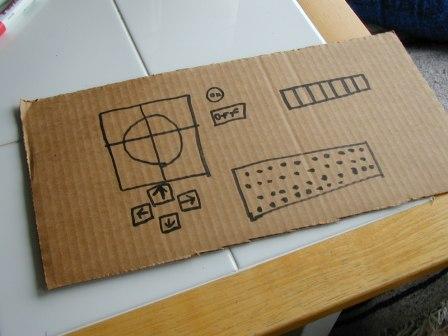 in order to make the base. And we only got a minimum of blue river glitter all over the floor. Happy Days. Small person decided that we really needed ladders in this fort too and they do make a nice touch. We have yet to put together the corral and the tipis but hopefully there will be time for that around everything else that's going on the next couple of days.
The net result so far is that this project is looking way cool and is "done enough" even if we don't get to the remaining finishing touches. Small person has had help, yes, and yet a lot of the work has been his own.  He chose the fort. He read all the materials I helped find and made a list of things he wanted to include in the overall display, found a lot of the supplies needed to make his vision a reality, and he has done most of the gruntwork that didn't involve spray paint or digit-severing implements. Especially with the size constraints placed on this project, it may be just as well that the Fort Phil Kearny that he built with his grandfather recently (and saved all this time just for this project) was not found intact.
I have to say I've definitely learned (or at least was reminded of) a lot too. Among them, things like... Spousal Unit is still better than I am at recognizing when we're at the point where it's advantageous to remember the enemy of good is better... how a tipi goes together... how stinkin' many people paraded west during the mass emigration that occurred in the mid- and late-1800's and how short a time window they had to make the trek... the value of making note of where we've been for future reference... how many of our skills get pressed into play in ways we never anticipated... different styles of leadership are needed from one moment to the next, even working with a single individual... and perhaps most important of all - kids (just like employees) often are capable of far more than we give them credit for.
Are you working on any cool projects you'd like to share or have some comments on parents doing schoolwork for kids - it's really about the equivalent of managers doing work for employees, isn't it? Send them to me at techsurvivor@soaringmountain.com - till then, Happy Trails!
In what new ways are your past skills and experiences still relevant?
~~.~~~.~~~~~.~~~~~~~.~~~~~~~~~~~.~~~~~~~~~~~~~
Kimm Viebrock is a Certified Professional Coach who helps technology professionals and service-oriented technology groups develop and use their skills more effectively and increase their value within the larger organizaion, allowing them to do more, do it better and have more fun doing it. Kimm is devoted to finding the connectedness in life.


 Posts
Posts


